

Salt Spray Testing
Salt Fog Corrosion Exposure Testing Services
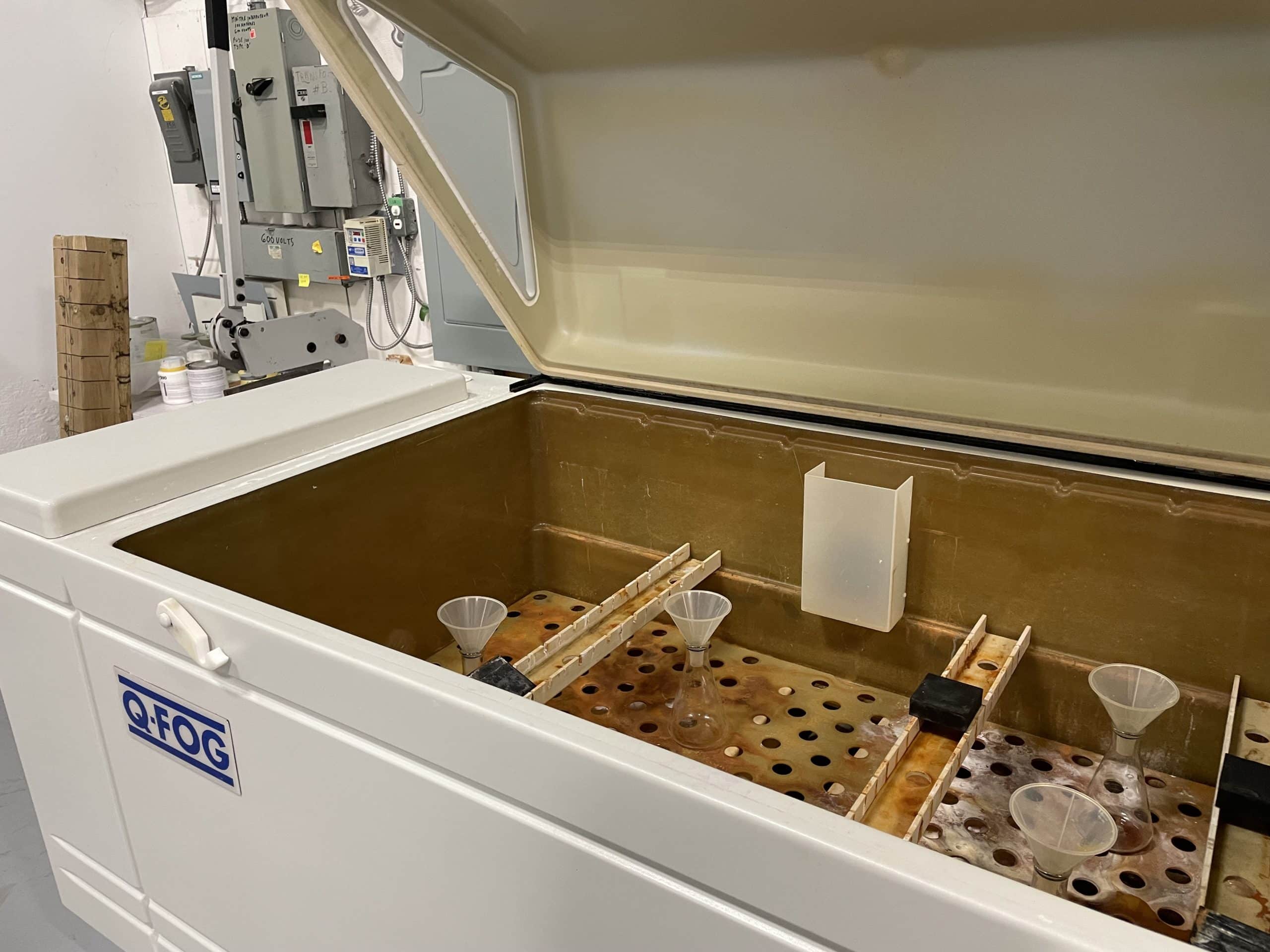
Micom Laboratories offers salt spray testing services to evaluate the corrosion resistance of coated, surface-treated, or other materials. As an ISO/IEC 17025 accredited laboratory by A2LA, we perform testing to recognized standards, including ASTM B117, MIL-STD, SAE, and various automotive OEM procedures. Our salt spray chambers simulate harsh corrosive environments so you can anticipate how your products will perform in the field. You can count on us to deliver reliable, repeatable results that help you qualify materials, improve coatings, and meet stringent industry standards.
Salt Spray Testing Standards We Use
Micom performs salt spray tests in accordance with multiple standards, including:
Automotive
- GM 4298P
- GM 9540P
- GMW 14872
- SAE J14563
Military
- MIL-STD 202
- MIL-STD 810 (m.509)
- MIL-STD 883C
Trust Micom Laboratories for Your Corrosion Testing Needs
- ISO/IEC 17025 accredited by A2LA
- Equipped with multiple salt spray and environmental chambers
- Serving clients across Canada, the USA, and beyond
- Expertise across many industries
- Ability to combine salt spray with complementary tests
When you partner with Micom, you gain not just test results but actionable insights that help you design durable products, avoid costly failures, and ensure compliance. Contact our corrosion testing specialists today to discuss your project.

What is Salt Spray Testing?
Salt spray corrosion testing (also known as salt fog testing or Q-Fog testing) is a widely used accelerated corrosion test method. It evaluates the durability of coatings, metals, and surface treatments when exposed to highly corrosive environments.
How Does It Work?
Specimens are placed in a controlled chamber, where a fine mist of 5% sodium chloride (NaCl) solution is continuously atomized at a temperature of 35 °C. This static exposure creates a uniform, salt-laden environment, accelerating the natural corrosion process.
Key Test Parameters
The test conditions are precisely defined, including:
- Solution pH
- Spray rate
- Specimen positioning
- Post-test evaluation methods
Why Use Salt Spray Testing?
Salt spray testing plays a critical role in quality control, product development, and compliance verification across sectors such as automotive, aerospace, construction, and coatings. This method of testing is widely used because it is:
- Cost-effective
- Fast
- Standardized and repeatable
However, this method has limitations, mainly because the constant salt fog environment does not fully represent real-world conditions, where corrosion is influenced by wet/dry cycles and UV exposure, among other factors. Despite these limitations, salt spray testing is widely used across industries such as automotive, aerospace, building materials, and coatings for the evaluation of corrosion resistance of finished parts and surfaces. It also remains widely specified because many companies have decades of internal performance data generated under ASTM B117 conditions, making it a practical benchmark for comparing new materials and coatings against established baselines.
About Cyclic Corrosion Testing
Cyclic corrosion testing is often used as a complementary method to better replicate real-world conditions and improve correlation with field performance. Unlike static salt spray tests, CCT alternates between wet and dry phases to more accurately simulate natural weathering. The test duration depends on the selected standard and the intended simulation. Some tests last a few hundred hours, while others, such as automotive cycles, may run for over 1,500 hours to provide a more complete picture of performance. While we run recognized ASTM, ISO, and automotive standards, Micom can also develop custom cyclic corrosion test procedures to reflect your product’s specific service environment.
About ASTM B117
ASTM B117 provides standardized corrosive conditions for salt spray testing. The cabinet temperature is maintained at 35 °C, with a 5% sodium chloride solution and controlled pH between 6.5 and 7.2. This method does not specify specimen type, exposure duration, or result interpretation. It is often used together with complementary ASTM methods such as ASTM D3359 for adhesion testing and ASTM D1654 for post-exposure evaluation of coating failure, including corrosion creep and loss of adhesion at a scribe mark.
Get Expert Help With Corrosion Testing
If you have any questions about salt spray testing or corrosion testing in general, contact us today. Our specialists will guide you in selecting the right test methods for your materials and industry requirements.
Frequently Asked Questions About Salt Spray Testing
How long does salt spray testing take?
The duration depends on the specification being followed. Some tests last 24–96 hours, while others extend up to 2,000 hours or more. Micom will recommend the appropriate test duration based on your material, coating, and industry requirements.
Which standards does Micom use for salt spray testing?
We perform salt spray testing to multiple recognized standards, including ASTM B117, ISO 9227, ASTM G85, ASTM D1654, MIL-STD 810, SAE J14563, GM 9540P, and other OEM-specific methods.
Can salt spray testing predict product lifespan?
Salt spray testing provides comparative data and is useful for quality control, but it does not perfectly replicate natural weathering. For more realistic field correlation, Micom Laboratories also offers cyclic corrosion testing and other complementary methods.
How do I submit samples for salt spray testing?
You can contact Micom Laboratories to discuss your project and shipping details. Our team will guide you through preparing and sending your samples to ensure compliance with the relevant standard.
What information do I need to provide before starting a salt spray test?
Before testing, Micom will ask for details such as the applicable standard, desired exposure time, number of samples, and any specific evaluation methods required. This ensures the test is carried out according to your exact needs.
Can Micom Laboratories combine salt spray testing with other corrosion tests?
Yes. Salt spray testing is often combined with complementary methods such as cyclic corrosion testing, humidity testing, or adhesion testing (ASTM D3359) to provide a more complete evaluation of coating performance.
Does Micom provide reports and interpretation of salt spray test results?
Absolutely. At the end of the test, you will receive a detailed report with test conditions, observations, and results. Our specialists can also help you interpret the data and recommend next steps if improvements or further testing are needed.