

ASTM D4459
Standard Practice for Xenon-Arc Exposure of Plastics Intended for Indoor Applications
ASTM D4459 is a standard that describes specific procedures and test conditions that are required to assess the stability of plastics that are intended for an indoor application. Indeed, the purpose of this method is to simulate the effects that are engendered by solar radiation through glass with an exposure to a glass-filtered Xenon arc illuminating light source. Thus, the ASTM D4459 relies on the guidelines of the ASTM G151 and of the ASTM G155 practices. Micom Laboratories is happy to offer ASTM D4459 testing as part of its UV testing and plastic testing services.
Xenon-Arc exposure of plastics for indoor applications
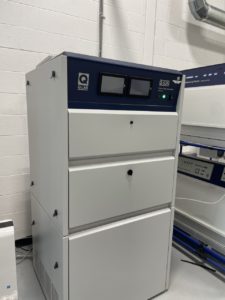 The ASTM D4459 standard mainly tries to characterize the evolution of the aesthetics of the plastic over time. More specifically, this method aims to appraise the color differences of the sample in accordance with the ASTM D2244 test protocol. In order to determine the variation of that property in terms of exposure time or radiant exposure, it is necessary to perform a periodical evaluation of the specimen. The time or radiant exposure required to provoke a certain property change can be used to ascertain the stability of materials. Furthermore, in order to foresee the performance of the sample into the field, it is necessary to have the appropriate acceleration factor. As a matter of fact, employing an acceleration factor that was obtained through an outdoor exposure or of another product will lead to flawed projections, because this factor is attributed to a specific material for a given situation. Lastly, even though a Xenon-arc light exposure is essentially used to assess the aesthetics, because the light source has an emission spectrum that matches the portion of the solar spectrum responsible for causing color fading, other properties may be gauged as well if this practice is coupled with the right methods.
Typical experimental parameters for ASTM D4459 testing
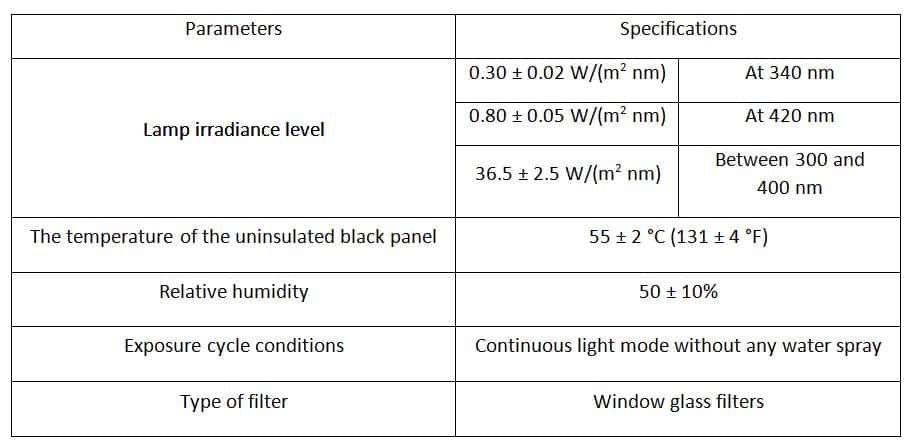
The number of samples required is three and it is recommended to test them alongside a material of known performance, so that the latter one can be used as a control. The specifications of the test are listed in table 1.
Table I: Specifications of the operating conditions of the equipment
Other test methods related to ASTM D4459
For additional related test methods, please see ASTM G155, Polymer testing, Accelerated aging.
If you have any questions about the ASTM D4459 test, we invite you to contact our material testing lab today. It will be our pleasure to answer your questions and help you with your custom plastic testing and material testing requirements.