

Cyclic Corrosion Testing (CCT)
Cyclic corrosion testing (CCT) is one of the most effective methods to evaluate how materials and coatings withstand exposure to real-world environments. As an accredited Canadian material testing lab, Micom Laboratories provides CCT corrosion testing services that simulate natural weathering with precision. Using advanced automated climatic chambers, we reproduce complex environmental cycles to deliver results that are both accurate and repeatable. Whether you need to qualify automotive parts, aerospace components, construction materials, or industrial coatings, our cyclic corrosion testing services give you the insights you need to ensure durability and compliance.
What is Cyclic Corrosion Testing?
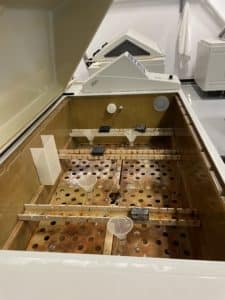
The cyclic corrosion testing method is designed to provide a more realistic approach to salt spray testing compared to traditional steady-state exposure tests. Since actual atmospheric exposures usually include both wet and dry conditions, by using cyclic corrosion testing, we can pattern accelerated laboratory tests after these natural cyclic conditions.
Research indicates that using cyclic corrosion testing results in the relative corrosion rates, structure, and morphology that are more similar to those observed outdoors. Consequently, this approach usually gives a better correlation to outdoor environmental conditions than conventional salt spray tests. Cyclic corrosion tests are effective for evaluating a variety of corrosion mechanisms, including general, galvanic, and crevice corrosion.
There are many ways to test for corrosion resistance using cyclic corrosion test standards, including ASTM G85, ASTM G44, ASTM D5894, SAE J2334, and ISO 11997-1.
This advanced accelerated corrosion technique is intended to produce material degradation and failures representative of those commonly found in outdoor corrosive environments. Simple exposures like prohesion may consist of cycling between salt fog and dry conditions. More sophisticated automotive methods call for multi-step cycles that incorporate immersion, humidity, condensation, along with salt fog and dry-off.
Working Principle and Procedure of Cyclic Corrosion Testing
Cyclic corrosion testing follows a systematic approach designed to replicate the environmental conditions that materials face in real-world applications. Unlike static salt spray tests, CCT alternates between wet and dry phases to more accurately simulate natural weathering.
The cyclic corrosion test procedure typically involves:
- Salt fog exposure: Specimens are sprayed with a corrosive solution to initiate degradation.
- Drying phase: Samples are dried, allowing moisture to evaporate and creating alternating cycles of corrosion and protection.
- Controlled cycling: Wet and dry phases repeat for predefined periods, with adjustments in temperature and humidity to mimic real environmental variations.
By following this methodology, CCT provides:
- Reliable data that closely mirrors outdoor performance.
- Insights into material resistance to corrosion over time.
- Support for material selection and design optimization.
Benefits of Cyclic Corrosion Testing
Realistic Corrosion Simulation
By alternating between wet and dry phases, cyclic corrosion testing mirrors natural weathering more accurately than traditional salt spray tests. This produces results that closely correlate with actual outdoor performance.
Better Material & Design Decisions
CCT provides manufacturers with actionable insights into how coatings, treatments, or assemblies will hold up in service. Weak points can be identified early, enabling design changes or protective measures before products reach the market.
Reliable Quality Assurance
Cyclic corrosion testing is a cornerstone for quality control in industries where durability and safety are critical. The data supports decision-making for product qualification and helps ensure materials meet customer and regulatory expectations.
Reduced Costs and Risk
By detecting vulnerabilities in advance, CCT helps minimize warranty claims, recalls, and unexpected maintenance. This translates into cost savings over the product life cycle and greater confidence in product reliability.
Compliance with Industry Standards
Micom performs CCT to ASTM, ISO, and automotive standards such as GM14872 and CCT-4, ensuring your results meet the requirements of global markets and sector-specific regulations.
Improved Customer Confidence
Products validated through rigorous corrosion testing are more likely to satisfy end-users and build long-term trust in your brand.
Cyclic Corrosion Testing in the Automotive Industry
The automotive sector has taken the lead in researching cyclic corrosion tests (CCT). Consequently, most of the procedures are geared toward automotive applications.
According to the research done by the SAE ACAP Committee and the AISI, GM14872 is currently considered one of the preferred cyclic corrosion test methods for automotive cosmetic corrosion (painted or precoated metals). This cyclic corrosion method requires an automatic cycling test chamber, similar to those used by Micom Laboratories, which is capable of running GM14872 exposure conditions, as well as many other automotive industry cycles. Among these, CCT-4, specified by some Japanese automotive manufacturers, was also shown in SAE and AISI research to closely correlate with actual vehicle corrosion results, making it another valuable test method for predicting real-world performance.
GM14872 Cycle
Exposure conditions:
- Electrolyte Solution 0.9% NaCl, 0.1% CaCl2 & 0.25 NaHCO3
- Solution Acidity pH between 6.0 and 8.0.
- Typical Durations 80 cycles (1,920 hours)
Exposure cycle:
- Salt Mist Application
- 90 minutes Ambient Conditions (25°C, 30 – 50% RH)
- Salt Mist application
- 90 minutes Ambient Conditions (25°C, 30 – 50% RH)
- Salt Mist application
- 90 minutes Ambient Conditions (25°C, 30 – 50% RH)
- Salt Mist application
- 210 minutes Ambient Conditions (25°C, 30 – 50% RH)
- 8 hours Humidity (95 – 100% RH)
- 8 hours Dry Off (60°C, <30% RH)
- Repeat
CCT-4 Cycle
Exposure conditions:
- Electrolyte Solution 5% sodium chloride
- Solution Acidity not specified
- Typical Duration 50 cycles (1,200 hours)
Exposure cycle:
- 10 minutes Salt fog application at 35°C
- 155 minutes Dry Off at 60°C
- 75 minutes Humidity at 60°C, 95% RH
- 160 minutes Dry Off at 60°C
- 80 minutes Humidity at 60°C, 95% RH
- 160 minutes Dry Off at 60°C
- 80 minutes Humidity at 60°C, 95% RH
- 160 minutes Dry Off at 60°C
- 80 minutes Humidity at 60°C, 95% RH
- 160 minutes Dry Off at 60°C
- 80 minutes Humidity at 60°C, 95% RH
- 160 minutes Dry Off at 60°C
- 80 minutes Humidity at 60°C, 95% RH
- Repeat
How can Micom help you?
With decades of expertise in accelerated aging and corrosion testing, Micom Laboratories is a trusted partner for cyclic corrosion testing across North America. We perform testing to ASTM, ISO, and automotive standards, and can design custom cyclic corrosion test procedures tailored to your product’s requirements.
If you have any questions about our cyclic corrosion testing services, please do not hesitate to contact our team. We will be happy to answer any questions you may have.
Related Testing Services
Explore complementary services:
Frequently Asked Questions
How Does Cyclic Corrosion Testing Compare to Traditional Salt Spray Testing?
Traditional salt spray testing (ASTM B117) exposes samples to a constant salt fog. It is quick and straightforward but does not replicate real-world wet/dry cycles, so results often overestimate corrosion and correlate poorly with outdoor performance.
Cyclic corrosion testing (CCT) alternates between salt fog, drying, humidity, and sometimes immersion, creating conditions much closer to natural weathering. This approach produces more realistic corrosion behaviour and predictive data, making it the preferred method in industries such as automotive and aerospace.
What Materials or Products Can Be Tested Using CCT?
CCT can be applied to painted, plated, and coated metals, protective coatings such as powder or galvanization, multi-material assemblies, and components in industries like automotive, aerospace, construction, and heavy industry.
What Industries Benefit Most from CCT Services?
Industries such as automotive, aerospace, construction, and marine utilize CCT to validate durability, predict lifetime, and comply with OEM or international standards for components regularly exposed to harsh or changing environments.
How Long Does a Cyclic Corrosion Test Take?
Test duration depends on the selected standard and the intended simulation. Some tests last a few hundred hours, while others, such as automotive cycles, may run for over 1,500 hours to provide a more complete picture of performance.
Can Micom Design Custom Cyclic Corrosion Test Procedures?
Yes. While we adhere to recognized ASTM, ISO, and automotive standards, Micom can also develop custom cyclic corrosion test procedures tailored to your product’s specific service environment.